It's been a busy few months for the flax field lab, with artwork, workshops, plenty of trial learnings and even a TV appearance. Colleen McCulloch, the trial's Coordinator, gives an update.
Background
The field lab involves growers who are part of an emerging network aiming to re-establish a regenerative textile (particularly linen) supply chain in the UK, with a specific focus on Scotland. The trial aims to test how well flax grows in a range of soil types, measured by crop establishment and yield; and to compare the performance of three Dutch varieties. Autumn 2025 saw the completion of the third growing season across three core sites in Scotland.
Takeaways from the trial
Suitability of Delta seeds in Scotland
The trial planted very late due to a delay in Dutch seed being available (there’s currently no UK supply of fibre flax seed), yet the crop established and grew well. The Delta variety had both longest straw length and highest yields overall – consistent with the 2024 crop – suggesting it might be the most suitable for the growing conditions in Scotland.
The impact of soil fertility, plus under sowing with micro clover
Soil type didn’t have a noticeable impact on yield. However, soil fertility had an impact on both straw length and yield. We’ve discovered that flax grows well without any inputs but performs better when fertility building has taken place – the plots which had been treated with compost or leaf mulch performed better than those without.
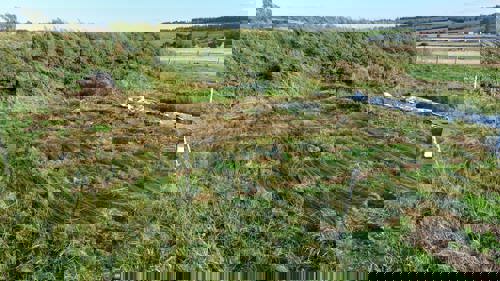
Undersowing the flax with micro-clover was also trialled again at one site to assess how well the clover could suppress weeds. Some weed cover was still present – most notably ‘fat hen’. Data analysis will show whether this had an impact on crop yield/ height compared to 2024.
Weathering the winter
Lauriston Farm trialled sowing some flax in the autumn too, to see if it can survive overwintering. At the time of writing (January 2026) it is looking well, even after some low temperatures and frost. It should have a head start and be ready to harvest early if there aren’t any more hard frosts.
A TV appearance
The flax field lab also featured (again!) this year on the BBC, this time with our volunteer harvest event shown on BBC Sunday Morning Live in October. Watch the segment from 44 minutes in to find out more.
Seed support, student involvement and more
Beyond the growing of the crop itself, there are now several related new pieces of work which are integrated with the field lab. One of these is a project funded by a Fibreshed micro grant to re-establish UK heritage varieties and develop seed saving capacity. This is especially pertinent as the seed supply was disrupted in 2022 and 2025. This meant the James Hutton Institute (JHI) site missed its 2025 planting window and must do their final plot trial in 2026.
Excitingly, Edinburgh College of Art (ECA) have also integrated the flax to linen process into their Textiles curriculum. They grew, harvested, dyed and processed flax into linen with last year’s students. Other related work includes engagement with farmers around flax as a fibre crop, supply chain scoping, options for small-scale mechanical harvesting, and hands-on outreach sessions on hand processing flax into yarn and linen fabric delivered by the ECA team and Fantasy Fibre Mill – including at Groundswell and Oxford Real Farming Conference.
Looking to the future
Our plans for 2026 and beyond include the final iteration of field trials at the JHI site, further developing seed saving capacity, developing heritage variety trials, and building stronger links, knowledge and capacity across the emerging UK regenerative textile supply chain.
Keep a look out for our final report and webinar in spring 2026.
The project is coordinated by facilitator Colleen McCulloch in collaboration with the James Hutton Institute and Edinburgh College of Art at the University of Edinburgh; with support from Fantasy Fibre Mill and Heriot Watt University, and trial seeds provided by seed specialists Elsoms Seeds.
Banner background image: Secret Linen Store